At the end of the summer term, I gave a presentation about promoting emotional literacy in school settings. Within the last year, I met two colleagues, Katie Trowse from ‘Rise With Katie’ and Bianca Osborne from ‘Soulful Sessions Mindfulness’. Together as a team, we presented together about different aspects of friendship challenges for children. Katie has lived experience with neurodivergence and coaches children and parents to offer support and neurodiversity affirming play sessions at her outdoor classroom, The Nest. Bianca runs after school mindfulness sessions for children. We are all based in Stockport, Greater Manchester. As soon as I met Katie and Bianca, I felt that our approaches were so aligned – we all want really positive and supportive things for children through our businesses. Please do look them up! This is so important for children with neurodivergence as recent research has shown that their time at school is tougher than for neurotypical children growing up. And mindfulness is a really well-evidenced approach and skill that we can all use in life – the research on it is compelling.
There is a fine line to navigate here because:
- A school isn’t a therapy setting
- Teachers aren’t counsellor; counsellors aren’t teachers (although saying that, I have two friends who are both!)
- Children will not have the language to process everything about their lives in their present – magical thinking and child development tells us that
- Schools and staff need to create and offer psychologically safe places and have a duty of care to everyone in the school community
- Schools do teach PSHE (personal, social, health and economic education) and although it is non-statutory, the guidance is that all schools should teach it.
In schools, I would suggest that there are 3As for staff which are:
– be the adult
– be authentic
– be accepting
This is within the context of our jobs and qualities as being professional, curious, calm/self-aware and open. Teachers also spend a lot of time thinking about how to judge a situation & how to respond at a specific time.

Context for emotional literacy in schools
There are many initiatives and approaches which have had an influence on schools within the last decade or so and provide more context when thinking about emotions, PSHE and school settings.
– Restorative
Many schools and local authorities in the UK have adopted practice based on Restorative Approaches. This means that there is a focus on bringing people together to talk about an issue, creating and asking questions which foster empathy and focusing on how to move forward and repair harm. This has developed from Restorative Justice and if you are interested about how it is embedded in an educational setting, I would suggest Mark Finnis’ book ‘Restorative Practice’ as a good place to start.
– Attachment & emotional security
Many local authorities and psychologists have offered training on attachment in recent years. Coined by John Bowlby, recent programmes like the Solihull Approach incorporate ‘attachment’ and science on the development of the brain in childhood and adolescence. Attachment is the responsiveness of the primary caregiver to the child especially in their first few years – humans can have a secure attachment or a disorganised attachment as their base and this can affect their emotional security into adult life and the way they navigate interpersonal relationships. There has also been a move to incorporate ‘trauma informed’ practice in educational settings which can have links to attachment. If you want to find out more about attachment then you can look at ‘Togetherness’ and ‘Attachment Aware Schools’ (Bath Spa University).
– Kindness as a principle
The book written by Dave Whitaker makes the case for kindness, understanding and compassion as crucial to develop good behaviour management in schools.
– Willing to flex and adjust
The growing awareness of neurodivergence has brought the differing needs of children to the foreground for many educators. The last fifteen years have been fascinating from an observational point of view – simultaneously, there has been a focus on evidence based practice, knowledge acquisition, zero tolerance and ‘slant’ which I have perceived as pretty rigid and structured, alongside a growing awareness that rigid school structures can need to flex for children with additional needs and neurodivergence. Paul Dix’s book ‘When the adults change’ is a clarion call for teachers and adults in school to set a positive, relational atmosphere to transform student behaviour.
– Emotion coaching
The emotion coaching approach has been developed by psychologist John Gottman and focuses on building emotional awareness, resilience and problem solving when working with children. Again, there is emphasis on understanding emotions and naming them.
Within the UK education context, the book ‘Emotion Coaching with Children and Young People in Schools: Promoting Positive Behaviour, Wellbeing and Resilience’ by Gilbert, Gus and Rose, explains the practical application of emotion coaching within schools.
Opportunity for culture

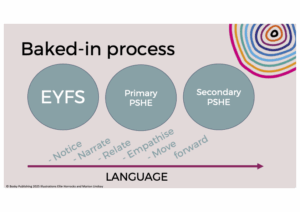
With all of these elements and aspects as a backdrop, I would pick out the following 5 things as being helpful to promote an emotionally literate culture within a school. Much of the language we use in schools builds culture and four out of five of these things are built with purposeful language. If you imagine emotional literacy as a cake (stay with me!), I think many people plan the structure of a school or organization and then think of the emotional literacy as an additional aspect like an icing on top. Alternatively, you can consider emotional literacy as a baked in flavour that permeates through the entire cake during baking.
1. Scripts
Choosing how we respond in different situations is so very important in school. When I went to training by Bill Rogers over twenty years ago, it helped me to appreciate the value of talking through what you could say in a variety of school situations – rehearsing ‘scripts’. For teachers or staff teams, you could generate these hypothetical situations really quickly and talk through the scripts that you would use for discussing or navigating the conversations that ensue. Avoiding caricaturing children and their circumstances and keeping kindness at the fore, I’d suggest to focus on words that validate perspectives, before widening the perspective by explaining that others could have perceived the situation in different ways.
I would think about five steps during the ‘script’ which would be: Notice, Narrate, Relate, Empathise, Move forward. I would argue that these aspects of practice are key to create a culture of emotional literacy.
You will find ideas for scripts and phrases within many of the approaches above.
2. Key phrases
This is where I think teachers can learn such a huge amount from counsellors and emotion coaching. There are phrases which help us to notice and narrate how we and other people feel in different circumstance. Whether we gather specific phrases from hearing specialists or whether we gather them from other teachers, the most crucial aspect is that we collect a bank of non-judgemental and compassionate phrases. These can help us to describe and name emotions and the circumstances which have impacted our emotions.
3. Visuals
This is very linked to analogies below. There are ways of understanding emotions which help us to visualise and grasp things that are very abstract – and emotions are not concrete. Visuals are incredibly helpful in all aspects of teaching. We know that multimodal learning can help us to make links and to engage with concepts.
4. Analogies
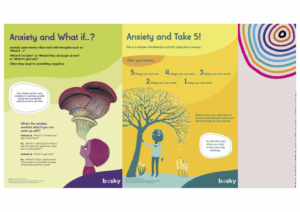
So much of verbal processing of emotions can feel very conceptual. An analogy, when used well, can help to give an explanation in a more accessible way. When Lindsay wrote the emotions poster pack, I found the ‘anger armour’ analogy so helpful. Anger and the connection with other emotions can be particularly difficult to understand and sometimes I think people can simplify and name anger without being compassionate about the complex layers of emotions.
5. Sharing a conversation/ shared language
The trouble about the first two parts of my five steps above is that without having the ‘buy in’ or the ‘relating’ involved in conversations about events or emotions then the conversation lacks power. (This is because the explanation is being done ‘to’ the learner/child rather than built in conversation ‘with’ the individual. There is information about the social discipline window model within Mark Finnis’ Restorative Practice book.) Therefore, part of ‘baking in’ emotional literacy involves creating a shared language to help us communicate and process within a school. Again, having training or sharing some of the approaches above, can help to build this shared language. Also listening to those from different perspectives e.g. counsellors, mindfulness practitioners, coaches and inclusion experts, can all help us to build a way of talking about emotions in a healthy and supportive way.
When we integrate these things well, it infuses the school culture. And it makes a difference – it helps staff to feel more secure navigating conversations and it helps learners to become more emotionally literate, reflective and resilient. A win all round
Thanks to Becky (who is an experienced Specialist Teacher for Inclusion and a trained coach) and Lindsay (a qualified teacher, SENCo and children’s counsellor) for their help with the background for the presentation.
Obviously, our Bosky Emotions Poster Pack was created to develop and promote language that helps when we are explaining and talking about emotions in schools. The posters are educational and general and are not meant to be individualised therapeutic advice.